

Mother Mary Comes to Me by Arundhati Roy
Arundhati Roy’s Mother Mary Comes to Me is a deeply personal and unflinchingly honest memoir that explores the tangled, transformative bond between a daughter and her extraordinary mother. Unlike her novels or political essays, this work turns inward- toward family, memory, loss, and the often-contradictory nature of love offering readers a rare and intimate portrait of the author herself as both child and creator.
From the very beginning, the book establishes its emotional core with raw immediacy. Roy begins in the aftermath of her mother’s death and then traces her life backward, weaving together formative memories from her childhood in Kerala, her youth in Delhi, and her eventual rise as a writer and activist. Central to this narrative is Mary Roy, formidable educator, visionary school founder, and women’s rights pioneer, a woman whose presence dominated Roy’s life and whose contradictions shaped her daughter’s emotional and intellectual landscape.

What makes this memoir riveting is the complexity of its central relationship. Mary Roy was no idealized matriarch. She was strict, often harsh, and prone to emotional volatility. A woman whom Roy describes with a mix of admiration, frustration, bewilderment, and love. This is not a tidy daughter’s tribute; it is a candid reckoning with a parent who was both “shelter and storm,” a person whose fierce independence and sharp intellect were matched only by personal flaws that left deep emotional marks.
Through lyrical prose, Roy brings these contradictions vividly to life. The reader sees Mary Roy not as a one-dimensional figure but as a force of nature; charismatic and cruel, generous and demanding, visionary and infuriating in equal measure. The memoir does not seek easy resolutions or sentimental closure; instead, it embraces the messiness of real life and real relationships.
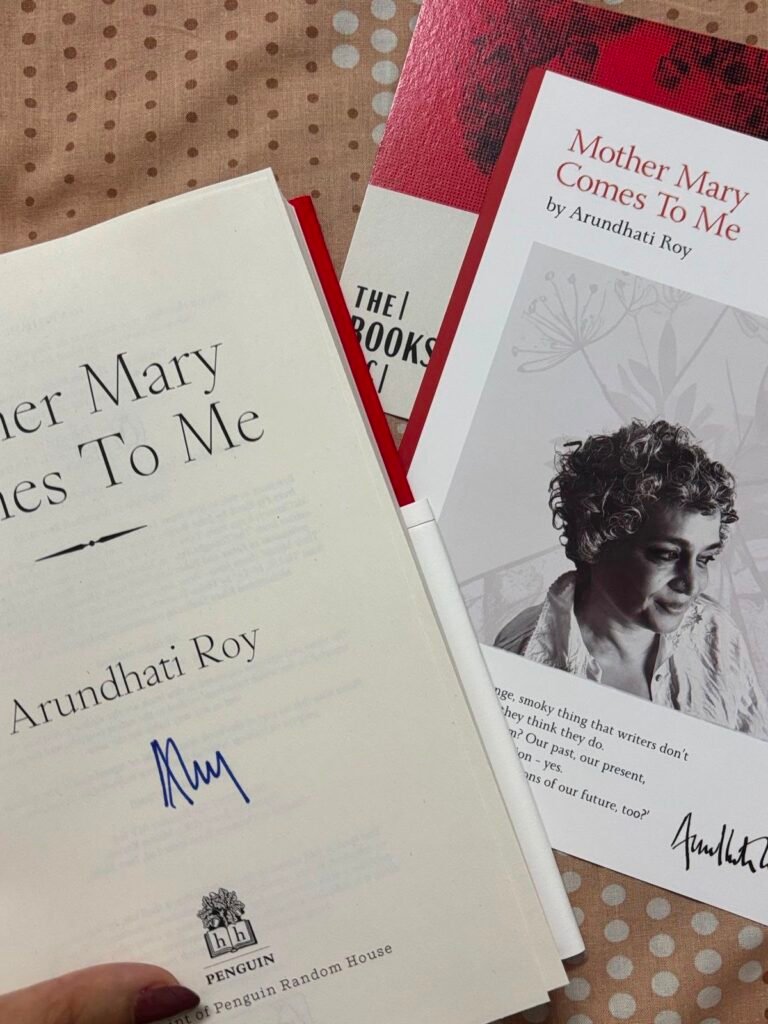
Alongside the intimate family portrait, the book unfolds as an origin story of sorts portraying how Roy’s childhood experiences, personal rebellions, and intellectual awakenings contributed to her becoming the writer and thinker she is today. Her descriptions of youthful years in Delhi, her early loves, and her creative explorations read with the same vividness and emotional texture that mark her celebrated fiction.
A striking aspect of the memoir is its tone: unsentimental, sharply observant, and capable of both humor and sorrow. Roy does not sanitize her story for comfort or clarity; she welcomes ambiguity, often lingering in the discomfort of unanswered questions and unresolved emotions. In doing so, she invites the reader into the work of understanding; not just of her mother, but of how love and pain can be intertwined inextricably.
Ultimately, Mother Mary Comes to Me is more than a family memoir. It is an exploration of identity, inheritance, and the ways in which the past with all its fractures and complexities shapes who we become. For readers drawn to deeply reflective and beautifully written life stories, this is a compelling, unforgettable read. Whether you admire Roy’s politics, her fiction, or simply her voice as a writer, this memoir offers something profoundly human at its heart.